
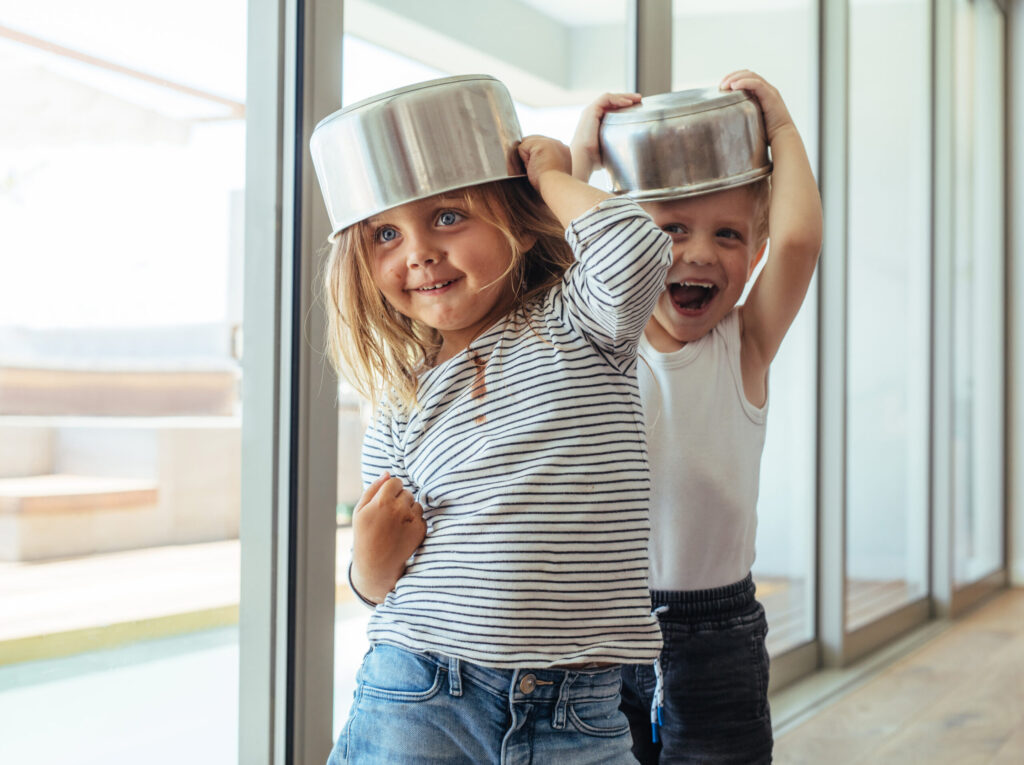
The value of learning through play often goes unnoticed, but the truth is that children learn more through play than through formal instruction. In fact, child psychologist Jean Piaget once said that “play is the work of childhood.” Years later, Mr. Fred Rogers stated that “play is often talked about as if it were a relief from serious learning. But for children, play is serious learning.” Play is an instinct for children and provides them with endless learning opportunities. Through play, children can freely choose what they want to do and how to do it. Things like time and goals are flexible, and there is rarely any fear of failure. This allows children to discover and develop new interests, practice skills, plan, revise goals, build confidence, and challenge themselves at their own pace. When children choose their own materials and plan their own activities, they engage in free play.
Adults can provide play materials and set up areas that encourage free play but also promote the practice of specific skills. For example, parents or caregivers who want to provide practice in writing and motor skills might add paper, pencils, and crayons to the play area with a child-sized table and chair. The adult is providing materials to practice the desired skills but using them is the child’s choice. Allowing children to freely use the materials you provide for play in their own way encourages them to be resourceful and creative learners. Consider how children respond to a large empty box. For them, it can become a pretend house, a boat, a cozy reading space, and much more.
When children play, they practice more than one skill at a time. They combine and repeat skills as needed until they master them. For example, a child reading a book to their friend is developing an understanding of language and literacy by talking, exploring new vocabulary, and understanding the purpose of printed words. But they are also developing physical skills such as holding the book, turning pages, using their eyes to track words and images; and social skills such as being gentle with the book and communicating with their friend. As children play, they practice and eventually master skills in all areas of child development, including language and literacy, social and emotional skills, mathematics and critical thinking, science, physical development (small and large muscles, flexibility, coordination, balance, and movement), and creative arts (drawing, art, music, dance, and pretend play).
Play materials do not have to be expensive. Consider asking friends or relatives to exchange toys with you, or to pass on toys they no longer need. Many materials can be purchased inexpensively from dollar stores, garage sales, thrift stores, or they can be checked out free from the public library. Other items can often be found around the home or made from recycled materials. There are also natural play materials such as sticks, stones, or leaves that children might choose to use as “food’ or “spoons” when pretending to cook outside.
Some inexpensive play materials children can use in multiple ways are paper, crayons, child-safe scissors, homemade playdough, sidewalk chalk, rulers and measuring tape, different-sized boxes, empty and clean food containers (butter tubs, cream cheese tubs, cereal boxes), kitchen items (measuring cups and spoons, pots, pans, bowls, wooden spoons, spatulas, ice cube trays, tongs), dress-up items (old costumes, clothing, scarves, shoes), pool noodles, balls, dolls, scarves, kazoos, whistles, bells, stuffed animals, puppets, buckets, toy phones, old keyboards, calculators, bed sheets, blankets, towels, rugs, blocks, and used gift cards can be pretend credit cards. Be aware of materials that may be choking hazards for infants and toddlers.
Encourage children to play both indoors and outdoors. If there is no outdoor space at home, look for a nearby park to visit. When children invite you to play, join in! This is an opportunity to build relationships and learn from each other. Allow children to take the lead and ask them questions like “What will you do?” or invite them to share their thoughts by describing what they are doing. The skills children learn through play also allow them to understand the purpose of learning. For example, a child counting out apple slices to make sure each person has the same amount is learning that counting is a tool for measuring and distributing things equally; that math has a practical value in their life. The next time you watch your child play, consider all that they are learning in a fun and natural way.
If an adult plans and directs play activities, it is not true play, but it can include playful elements and offer learning experiences. An adult planning play should focus on activities that are based on children’s current interests and provide the materials they will need to be successful in completing the activity. Directions for the activity should be minimal and easy for children to follow on their own. Children should have enough time to play without feeling rushed. Examples of adult-directed play might include organized sports, science experiments, or other activities with a fixed goal. Screen time activities are not considered to be true play because the child is being directed by the program or game; however, there are learning benefits to children using appropriate media when it is monitored by an adult.
You can discover Activity Guides for play that are free or low-cost on the Children’s Home Society of California’s (CHS) website. There are Activity Guides for free play, adult-directed activities, and making toys that can be used with infants, toddlers, preschoolers, and school-age children. CHS also offers a variety of free family and child care provider workshops and additional resources related to play and understanding child development. Additional resources are noted below.
References and Additional Resources
- 10 Things Every Parent Should Know About Play from the National Association for the Education of Young Children (NAEYC) available at https://www.naeyc.org/our-work/families/10-things-every-parent-play
- Activity Guides that offer free or low-cost learning ideas for families and child care providers from CHS are available at https://chs-ca.org/programs-services/access-educational-materials-and-trainings/activity-guides
- Embracing Learning Through Play from the Harvard Graduate School of Education available at https://www.gse.harvard.edu/ideas/usable-knowledge/23/05/embracing-learning-through-play
- Fun and Simple Playdough Recipe is a video from 4C for Children available at https://youtu.be/Mc1Eq1x4Kes
- Great Outdoor Activity for Kids: Mud Kitchen is a video from Woodland Classroom available at https://youtu.be/rjH-wMXhNAI
- Kids and Media Use: How to Build Healthy Habits from Nemours KidsHealth available at https://kidshealth.org/en/parents/tv-habits.html
- Learning through Play is a Sesame Workshop available at https://sesameworkshop.org/topics/parenting/learning-through-play/#
- Make the Most of Playtime (with infants and toddlers) from the National Center for Pyramid Model Innovations (NCPMI) available at https://www.challengingbehavior.org/document/make-the-most-of-playtime
- Play Resources from the National Institute for Play are available at https://nifplay.org
- Play Based Learning with Dr. Peter Gray is a video from the Early Childhood Education and Training Program (ECETP) available at https://youtu.be/wJaAegok8L4
- The Power of Play: How Fun and Games Help Children Thrive from the American Academy of Pediatrics and is available at https://www.healthychildren.org/English/family-life/power-of-play/Pages/the-power-of-play-how-fun-and-games-help-children-thrive.aspx
- The Powerful Role of Play in Early Education is a free PDF book from the California Department of Education available athttps://www.cde.ca.gov/sp/cd/re/documents/powerfulroleofplay.pdf