
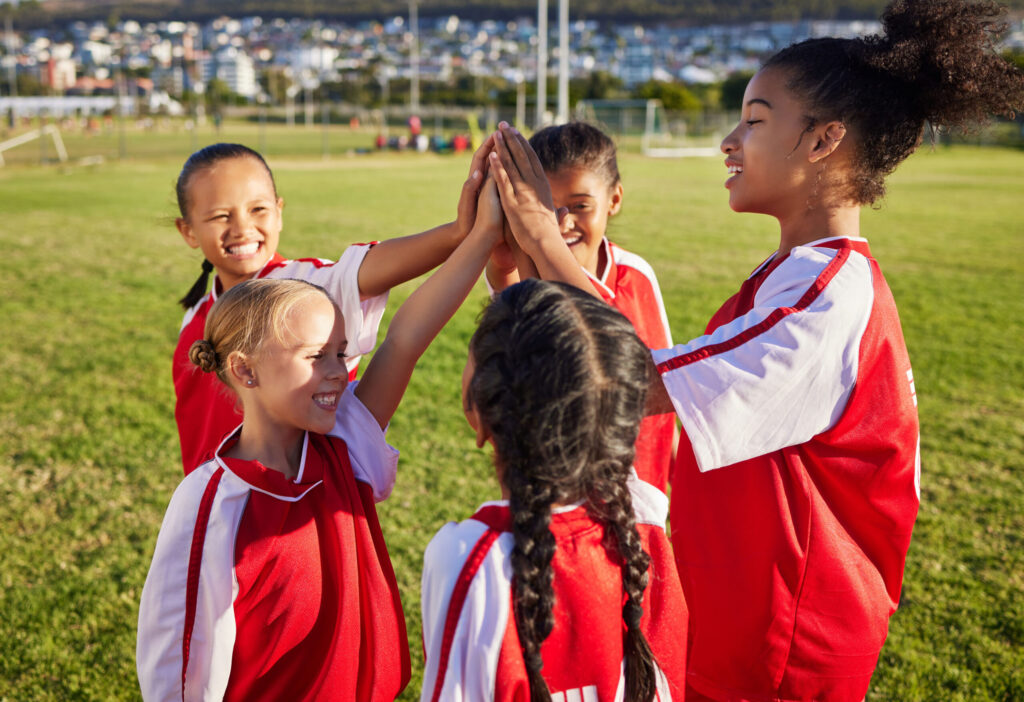
As children grow, it’s inevitable that they will face competition. Whether it’s organized sports, a spelling bee, striving for an award, top academics, or simply rooting for a sibling during a competitive encounter, they’ll need to learn to manage their emotions and develop a healthy attitude towards competing with others. While the desire to stand out or be a winner in competitive situations may be strong, caregivers can encourage developing children to stay focused on kindness and support for others while trying to perform at their best. Since competition is a natural part of life, in today’s blog, we will look at why supporting healthy competitive attitudes is beneficial for young learners.
What is Healthy Competition
Understanding humans’ innate drive to compete is complex, especially as it relates to children. On the one hand, competition can provide personally fulfilling opportunities and outcomes for individuals and as a team member. On the other hand, an imbalanced approach that does not emphasize respect for others or help children recognize their worth, win or lose, can lead to negative experiences.
Although a child’s first encounter with competition may occur when learning to share toys or in a contest for an adult’s attention, it is often through organized competitions, such as sports, that children cultivate healthy competitive mindsets.
According to Parker Huston, PhD, of Central Ohio Pediatric Behavioral Health, healthy competition positively motivates children towards self-improvement and challenges them to aim higher by focusing on the process, not a particular outcome. Additionally, healthy competition ensures that having fun and collaborating are as important as setting personal goals that focus on competing against themselves rather than others.
Since 1991, the first Tuesday of March each year has been dedicated to celebrating National Sportsmanship Day. Established to encourage fair play, good manners, and upstanding character, this ongoing effort to promote good sportsmanship in the US reminds us that there is more to sports than being the best or winning.
Celebrating this holiday every year is an excellent opportunity to keep practicing the principles of healthy competition and fostering the resulting resilience.
Next, we will discuss the benefits of creating a physically and psychologically safe environment for children practicing healthy competition.
The Benefits of Healthy Competition
Competitive encounters offer young learners many benefits when parents and caregivers provide inclusive, ongoing support in appropriate environments. Research shows the following benefits can be gained from healthy competition:
| Physically Active Lifestyle | The influence of family, coaches, and age- appropriate guidance are key factors when children compete in physically active competitions, such as sports. It can provide positive developmental effects that lead to lifelong healthy habits. |
| Improved Effort and Skill Building | Children may be motivated to try harder to improve their performance or acquire new skills when activities are presented in a balanced competitive format. |
| Social Connections | Competitions provide opportunities for children to make friends and have fun, while developing and practicing social skills. |
| Personal Development and Problem-Solving | Healthy competition can help early learners experience teamwork and learn good sportsmanship, such as respecting team members and other competitors. They are able to set goals, work through difficulties, and be taught that there is value in both winning and losing. |
| Neurocognitive Development | Recent studies show participation in sports is positively associated with enhanced brain function. |
Given these benefits, organized competitions in children’s leisure time and learning activities are commonplace in today’s society. Whether playing board games, neighborhood tag, or competing in robotic STEM challenges through school, opportunities for healthy competition are often woven into everyday activities. Children may also be exposed to competitive environments in organized sports, like gymnastics, Little League baseball, and Pop Warner flag football.
There are varying opinions about competition. Some adults believe preparing children for a competitive world as early as possible is essential. However, it’s also common for adults to associate negative influences with competition, such as pressure to win, acquiring status above all else, and the potential for children to make unhealthy comparisons between themselves and others.
Although many factors contribute to the various attitudes about competitive sports during pre-adolescence and adolescence, the American Academy of Pediatrics recent clinical report notes that “parental support for organized sports in general, with focus on development and fun instead of winning, has emerged as a key factor in the athlete’s enjoyment of sports.”
While it may seem that winning should be the main ambition, and it certainly adds to the fun, often for early childhood competitors, demonstrating they can dribble a ball or swim in the deep end, is of more value than competition. Developing a healthy competitive mindset is most beneficial when children are allowed to succeed by showing their abilities, rather than focusing solely on winning.
Fostering Healthy Competition
Whether you are convinced that competitive sports should be played as early as possible or postponed until a child is developmentally ready, how children compete makes all the difference.
Research suggests that parents, caregivers, and coaches take the time to help young children become familiar with competition by ensuring everyone has a chance to participate. In this way, they can master fair play, practice respect for others, and learn to be cooperative when competing. These approaches foster a healthy competitive environment that promotes a child’s personal development and encourages them to discover their strengths. For example, supporting others is a leadership skill. They can also learn to focus on the process and set goals for improved performance rather than comparing themselves to others. Children can also come to understand that a loss today is not a loss tomorrow; that their power to overcome obstacles “wins” every day of their lives.
If your family is looking for early learning support at home or if you are an early learning educator seeking supportive resources to enhance your child care services, consider attending a CHS workshop to access additional early learning topics and activities.

Do you or does someone you know need help paying for child care?
¿Usted o alguien que conoce necesita ayuda para pagar el cuidado infantil?
Please visit chs-ca.org today.
Visite chs-ca.org/es hoy.
References and Additional Resources
https://chs-ca.org/wp-content/uploads/2026/01/CHS-Self-Esteem-English_2025.pdf
https://chs-ca.org/chs-blog/jan-2025-family-fitness-activities
https://nationaltoday.com/national-sportsmanship-day
https://www.canr.msu.edu/news/rethinking-competition-how-to-foster-healthy-rivalry-in-4-h
https://www.copbh.org/blog/healthy-competition-in-sports
https://pmc.ncbi.nlm.nih.gov/articles/PMC11750462
https://pmc.ncbi.nlm.nih.gov/articles/PMC4554955
https://www.psychologytoday.com/us/blog/open-gently/202207/how-competitions-are-good-kids
https://odphp.health.gov/sites/default/files/2020-09/YSS_Report_OnePager_2020-08-31_web.pdf
https://www.parents.com/signs-your-child-is-too-competitive-11778684