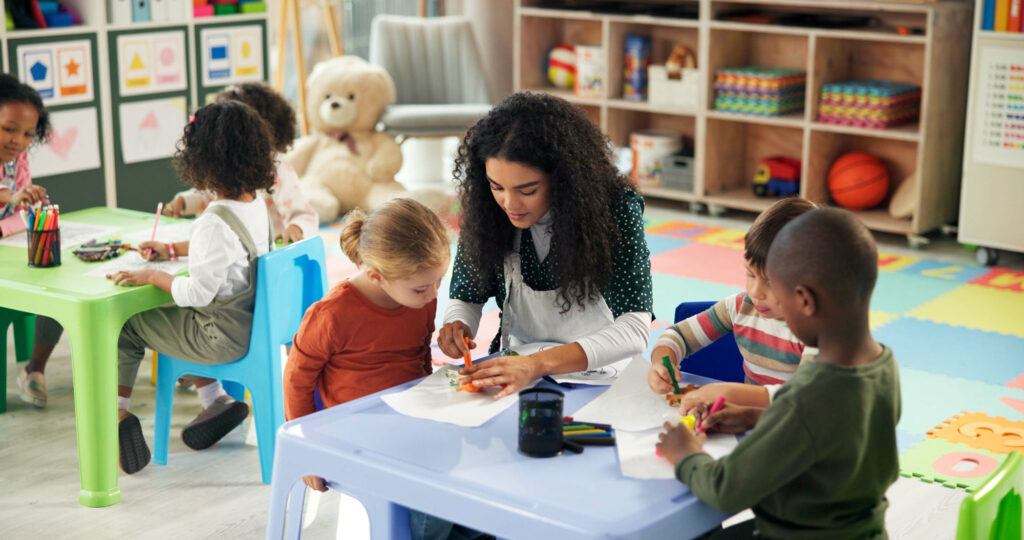
Every child needs a safe, healthy, and secure place to grow. Research shows that children of all abilities learn and thrive best in well-supported inclusive programs. Benefits include better social skills, stronger academic and cognitive growth, more empathy, and higher confidence.
Are you a family child care home provider who wants to improve your program? Or a parent getting your child ready to start school? Either way, it helps to know what inclusive early learning looks like. In this blog, we’ll share what to look for.
Why Inclusion Matters
Inclusive education supports children’s brain growth and development. The California Department of Education uses Universal Design for Learning (UDL) to support inclusive learning. UDL looks at how people learn, helping educators provide a mix of instruction and support that reflects how the brain works.
The National Association for the Education of Young Children (NAEYC) sets standards for high-quality early learning. NAEYC also incorporates UDL ideas into its guidelines for educators and offers simple ways for child care providers to make their programs more inclusive.
At Children’s Home Society of California (CHS), we create evidence-based resources and workshops that reference NAEYC’s standards. These tools help child care providers create high-quality, inclusive programs. CHS also supports parents in selecting the right child care for their family through our Choosing Child Care brochure, workshops, and the Resource and Referral (R&R) hotline.
Below are the professional standards, brain-based benefits, and examples of high-quality inclusion that we cover in CHS’s free workshop, Pillars for High-Quality Early Childhood Education:
Ways to Get Kids Interested (Engagement)
Engagement is about the “why” of learning. It connects to the part of the brain that handles feelings and emotions.
Educators who value inclusion know every child is different. Each child is motivated by their own experiences, interests, and goals. That’s why it’s important to offer choices that connect to each child’s life. This builds their thinking skills, confidence, and love of learning.
| What to do | What it looks like |
| Welcoming each child’s interest and identity | Maintain small child-to-staff ratios, so staff can nurture relationships. Talk often with families, in person or online. Educators should reflect on their cultural competency and what children are expressing. |
| Offer choices and independence | Use play-based learning, like building blocks or pretend play. Adjust tools and activities to match a child’s current abilities. |
| Watch for biases and distractions | Welcome each child’s interests, identities, background, special needs and/or accommodations, race, gender, and culture. Notice and address any biases. Help every child feel like they belong. |
Ways to Share Information (Representation)
Representation is about the “what” of learning. It connects to the part of the brain that helps us understand what we see and hear.
Educators who value inclusion share information in different ways, such as pictures, sounds, hands-on activities, or digital formats. At the same time, they include cultural subjects, languages, and information that help children connect and learn, no matter their abilities.
| What to do | What it looks like: |
| Help a child take in information | Follow Developmentally Appropriate Practices (DAP) Tailor teaching and learning to a child’s age, needs, culture, and developmental stage. Scaffold (help connect one level of learning to the next, like a bridge) learning opportunities and maintain predictable routines. |
| Use different words/languages and symbols | Include home languages by labeling the environment in the child’s native language, singing songs, and reading stories from different cultures. Create picture schedules or pair print with familiar community symbols, e.g., a stop sign. Narrate daily routines, describe what you are doing while you are doing them, and introduce “stretch” words by using rich and descriptive language. For example, instead of saying, “Look at the big dog,” say, “Look at that enormous, fluffy dog.” |
| Help kids build knowledge | Effective strategies include asking open-ended questions to prompt the child to think more deeply about what they are observing. Acknowledge and describe what the child is doing with specific feedback. For example, instead of saying “great tower,” say “You put the heavy, wide block at the bottom to make a steady and tall-looking building.” |
Many Ways to Show What They’ve Learned (Action and Expression)
Action and expression are about the “how” of learning. It connects to the part of the brain that plans and carries out actions.
Educators who value inclusion know that every child learns in their own way. They provide children with opportunities to choose how they show what they have learned and ways to make sure children can access the tools they need.
| What to do | What it looks like |
| Set up the space well | Design the environment with dedicated areas (e.g. block area, art, science, music, reading nook, etc.). Keep materials accessible so children can reach them without assistance. Make sure furniture can be maneuvered to be inclusive. Make various textured toys available (soft, bumpy, etc.) and use neutral colors. Rotate materials to match the child’s changing interests. |
| Support communication | Practice active listening, get down to the child’s level, listen to understand, and acknowledge all attempts of communication. Encourage conversations, follow the child’s lead, and wait for a response. Consciously use structural supports, such as gestures and cues. For example, use facial expressions, body language, and props to provide meaning to spoken words. Facial Expressions: Use wide eyes and a gasp when saying, “The bear was so surprised!” to teach emotional vocabulary. Body Language: Shiver and wrap your arms around yourself while saying, “It was a freezing winter day.” Physical Props: Hold up a real, crunchy leaf while reading a story about autumn so children can see, touch, and hear what “crunchy” means. |
| Plan ahead | Set clear goals for what children will learn. Build new skills on what children already know. Slowly let children try things on their own to build confidence. Always include culture, language, and each child’s needs in your planning. Set up materials ahead of time. |
Putting It All Together
These core principles help child care providers support every child, every day. With a high- quality, inclusive program, children can gain knowledge, make choices, participate, and enjoy learning.
Want to learn more? Check out our Special Needs brochure, or read our other blog, Could Assistive Technology Help Your Child? We also encourage you to attend our workshop, Pillars for High-Quality Early Childhood Education, and check out upcoming workshops and events. Visit www.chs-ca.org to learn more.
Resources and Referrals
https://www.caeducatorstogether.org/resources/218446/inclusion-toolkit
https://www.cast.org/wp-content/uploads/2024/12/cast-udlandthebrain-20220228-a11y.pdf
https://www.naeyc.org/resources/pubs/yc/spring2022/equity-teachers
https://www.naeyc.org/resources/pubs/yc/spring2022/equity-teachers
https://chs-ca.org/wp-content/uploads/2022/01/FEP_ChooseCare_2017_English_web-2.pdf
https://chs-ca.org/workshops/list/?tribe-bar-search=choosing+child+care
https://udlguidelines.cast.org/static/udlg3-graphicorganizer-digital-numbers-a11y.pdf
https://chs-ca.org/wp-content/uploads/2022/01/CHS_Special_Needs_Caregivers_English-1.pdf
https://chs-ca.org/chs-blog/sept-2025-could-assistive-technology-help-your-child
https://chs-ca.org/chs-blog/sept-2025-could-assistive-technology-help-your-child